Three Ways to Get a Crypto Platform — And Who Needs a Licence to Run One
Most companies that want a crypto or payments platform start in the same place: a developer quotes twelve months, the budget doubles halfway through, and the first compliance audit finds gaps nobody designed for.
There is another route. We built a crypto and fiat platform, ran it in production under European supervision for four years, and now deliver it to businesses that want to run it themselves. Below is how that works, what it means for your regulatory position, and who it actually fits.
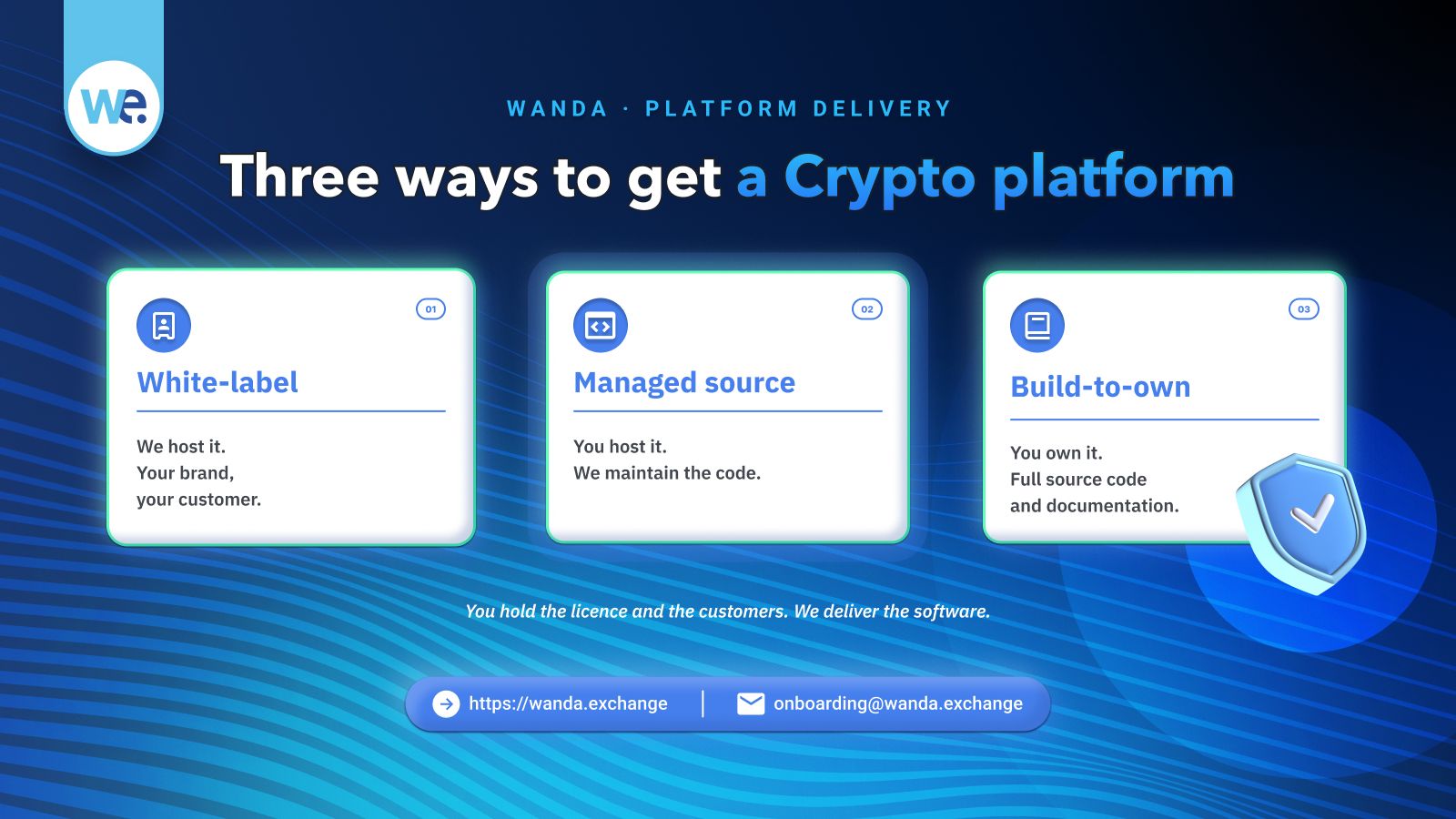
Three ways to take the platform
White-label
Our full platform under your brand and domain, hosted and maintained by us. Your customers see your product; we keep the infrastructure running, ship updates and handle the technical operations.
This is the fastest route to launch — weeks rather than quarters and the right one if your team is commercial rather than technical, or if you want to test a market before committing engineering resources to it.
Managed source
You host the platform in your own environment and keep full control of your data and infrastructure. We maintain the code, deliver updates and provide support.
This suits institutions with data residency requirements, an internal security policy that rules out third-party hosting, or a regulator that expects the operator to control its own systems — but that do not want to take on a permanent development team.
Build-to-own
We build to your specification and hand over the complete source code and documentation. You own the technology outright, with no licence fee and no ongoing dependency on us.
This is for companies that treat the platform as a core asset: firms planning to build their own product roadmap on top of it, or ones whose investors expect the technology to sit on the balance sheet rather than in a vendor contract.
And the option in between
Not everyone needs a whole platform. If you already run a system that works, we integrate individual modules into it — KYC and KYB flows, wallets, a trading engine, payment rails, an admin panel, an audit trail. The same components, delivered into your architecture rather than replacing it.
What this means for your licence
The delivery model does not change your regulatory position. We are a technology vendor: we do not hold client funds, do not provide custody, and do not carry out exchange activity. Our clients operate under their own authorisations, and the platform is configured to whatever regime they sit in.
Under MiCA, a crypto-asset service provider in the European Union needs authorisation in one member state and can passport it across the bloc. The platform is built around what that requires: onboarding and KYB flows, transaction monitoring, Travel Rule support, segregated record-keeping, and an audit trail designed to be read by a supervisor rather than reconstructed for one. We built those flows because we were the ones being supervised.
Outside the EU the architecture is the same and the configuration differs. FCA registration in the United Kingdom, FINMA and SRO membership in Switzerland, VARA and ADGM in the United Arab Emirates, the Royal Decree on Digital Asset Businesses in Thailand, SEC registration regimes across Latin America and Asia — each has its own thresholds, reporting obligations and prohibited activities. Compliance rules in the platform are parameters, not hard-coded assumptions, so the same codebase runs under a different regulator with different settings.
Two markets deserve a specific warning. On the UAE mainland, merchants may only accept a dirham-backed stablecoin from a Central Bank–licensed issuer. In Thailand, crypto payments for goods and services are prohibited outright. In both, the buyer pays a licensed converter and the seller receives local currency — the customer experience is identical, the legal path is not. We build both flows.
Who actually needs a licence
This is where most of the confusion sits, so it is worth stating plainly.
You need a licence if you handle crypto on behalf of other people. Holding customer balances, converting for customers, moving funds between third parties — that is custody, exchange and transfer, and every major regime regulates it. Exchanges, brokers, custodians, payment institutions and fintechs building wallet products are all on this side of the line.
You do not, in most jurisdictions, if you receive crypto as payment for your own goods. A seller who gets paid is a seller who got paid. That is commerce, not a financial service.
Three situations move a business across that line without anyone noticing: letting customers keep a balance in your system, converting on someone else's behalf, or routing money from A to B where neither is you. Each starts as a convenience feature and ends as an unlicensed regulated activity.
Who this is for
Licensed institutions — exchanges, brokers, payment institutions, EMIs and banks adding a crypto layer to a regulated business that already has customers and fiat rails. You have the licence; what is missing is the technology behind it.
Fintechs and payment providers entering digital assets, where the choice is between an eighteen-month build and a platform that already works.
Companies that want to own their code rather than rent it, whether for strategic, commercial or investor reasons.
And sellers of high-value goods — diamonds and precious stones, gold and metals, watches, cars, art, property. If your buyers are abroad and wiring money takes days or gets blocked, a sales platform under your own brand that verifies the buyer, locks the price, and settles through a licensed provider to your bank account solves a problem you have probably been told is unsolvable. Most dealers in this group need no crypto licence at all — their AML obligations are the ones they already have.
Where to start
One call, thirty minutes. We map what you need, what you already run, and which regime you operate under. By the end of it we can usually say whether you are looking at a three-week integration or a six-month build and give you a fixed price for it.
Wanda Exchange Co., Ltd. is a software development company. We build, license and integrate crypto and payment platforms for businesses — under their brand, in their environment, or delivered as full source code. We do not hold client funds, provide custody, or operate regulated services; our clients operate under their own licences. This article is general information, not legal advice: licensing questions depend on your jurisdiction and your specific activity.
Tell us what you are building →
Wanda Exchange is listed among software development companies on DesignRush. — As seen on DesignRush